Heart of the Cards
Heart of the Cards was a 4-month Unity project built around an unusual concept: a deckbuilder where the cards are your personality, and the goal is to survive a date. The idea was strong. The execution ran into problems. The project was eventually cancelled before completion — but it taught me more than most projects that shipped.
The Concept
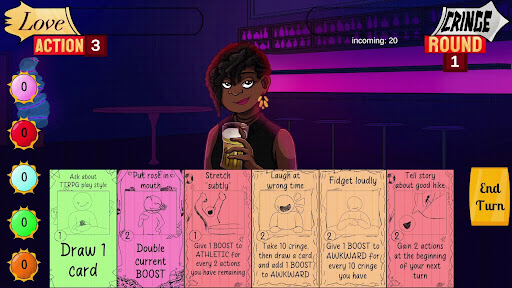
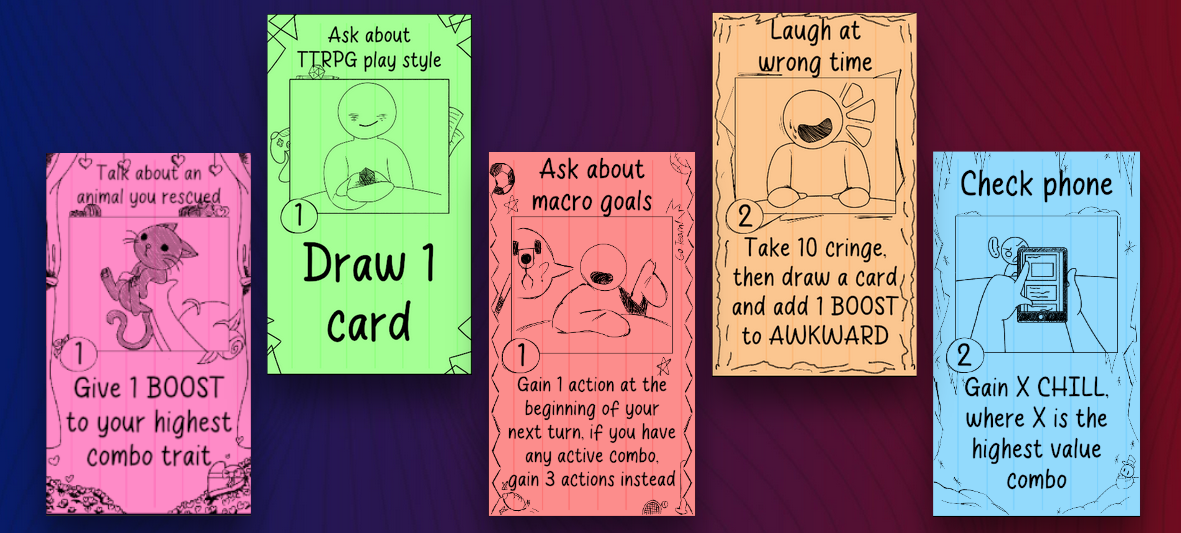
Players would build a deck of personality cards — Charming, Nerdy, Athletic, Awkward, Frosty — and play them on a date to raise their Charm score while managing incoming Cringe. Each card had conditional mechanics: some boosted based on combo counts, some drew extra cards depending on hand state, others added or subtracted actions for the current or next turn. The system had a lot of moving parts, and designing them to interact cleanly was the central programming challenge.
What I Built
I owned the core game systems and data layer for most of the project.
Game state & data architecture — The GameManager held all global state: card lists organized by type and pack, the draw pile, discard pile, cringe events, boost and chill value dictionaries, and the round counter. I also designed the Date, Card, and CringeEvent data models that the rest of the game ran on.
Card mechanic system — Each card carried up to four conditional mechanic objects: BoostMechanic, ChillMechanic, DrawCardMechanic, and AddActionsMechanic. Each had multiple branching conditions — checking combo state, card type, hand size, chill values, and more — that resolved at play time. Writing these as clean, composable classes rather than hardcoded switch statements made the card design space much easier to extend.
Combo tracking — ComboManager tracked how many consecutive cards of each type had been played, displayed live counts in the UI, and fed its values into the mechanic resolution system. It ran as a singleton so any system could query it without coupling tightly to the scene hierarchy.
Pre-date flow — I built the Timber profile browser (the dating app swipe screen), the Research card pack selection screen, and the PersonalityQuiz that set your starting deck archetype. These three scenes formed the entire pre-date loop before the main date scene.
End screen — EndSceneManager read the final Charm and Cringe values from GameManager and displayed the appropriate result — good date, bad date, or somewhere in between.
What Happened
The design scope was too ambitious for the team size. With only two designers stretched across a mechanic-heavy game, a lot of systems never got properly defined before programming had to implement them. By the time problems surfaced, it was too late in the timeline to course-correct. The project accumulated half-finished features, unexplained mechanics, and a programming crunch toward the end that prioritized functionality over organization. Heart of the Cards did not get greenlit, and the team disbanded.
What I’d Do Differently
Get into design meetings earlier. A lot of the scope problems were visible in the design documents before a line of code was written — I just wasn’t in the room yet. Pushing for cleaner data contracts between design and programming earlier would have prevented a lot of the late-stage scramble. Sitting down members who couldn’t agree on what to do.
I’d also have advocated harder for a playable vertical slice in the first month. Having something testable early forces scope decisions before they become crises.
Heart of the Cards was never publicly released.